What does US-Iran crisis mean for ordinary Nigerians?
By Daylight
March 4, 2026
Iran war bombing
When the United States and Israel launched air strikes on Iran on Saturday, many thought the renewed conflict would be between just the trio as usual. But days after, it escalated to other parts of the region.
The US-Israeli strikes on Iranian targets killed Ayatollah Ali Khamenei, Iran’s supreme leader, and Abdolrahim Mousavi, the armed forces chief of staff. Khamenei’s daughter, grandchild, daughter-in-law and son-in-law were also killed in the military operation.
In response, Iran launched waves of missiles across the Middle East region, targeting the United States’ (US) military bases in the United Arab Emirates (UAE), Kuwait, Saudi Arabia, Qatar, and Oman. Iran has also warned that the crisis would engulf the whole world. While there are already signs of a global economy awaiting an explosive disruption, Africa and Nigeria are not immune to the ripple effects of a war that has subjected supply chain flows to risks.
In this piece, TheCable examines how the escalation could influence African markets in the coming weeks, with particular attention to Nigeria.
WHAT MAKES THE WAR DETRIMENTAL TO AFRICA AND NIGERIA?
Although vengeful fighter jets may not fly across Africa’s airspace and the continent’s soils may not be split by missiles, the interconnectedness of the world presents risks that Nigerians and broader Africa cannot ignore.
Geographically, Africa and the Middle East are said to be directly adjacent, sharing borders across the Red Sea, with the shortest distance being approximately 26 kilometres across the between Djibouti and Yemen. The two regions are also connected by Egypt’s Sinai Peninsula, creating a land bridge between the continents.
Speaking during a virtual forum, Toyin Falola, a professor of history, warned that any escalation in the Middle East would have consequences for Africa.
“This is going to affect Africa. If people think this will not affect them, then they do not understand how geopolitics works,” Falola said.
“Where Iran is located in its region is connected to Africa. Dubai is a hub; it has closed its airport since the attack on Iran.”
Furthermore, given its proximity to East Africa, the Middle East remains closely linked to the continent, particularly as it is home to the Strait of Hormuz, a critical passageway for the movement of goods and crude oil not only to other continents but also to Africa.
WHAT IS THE OUTLOOK FOR AFRICA’S OIL INDUSTRY AND HOW DOES IT AFFECT NIGERIA?
The crisis has already driven notable shifts in global crude oil prices. On March 3, oil Brent rose to $85 per barrel — from $72 on February 28.
In addition, critical oil and gas facilities have, so far, been closed due to damage or as a safety measure over attacks in the Middle East region — an oil and gas powerhouse.
On March 3, QatarEnergy, the state-owned energy company of Qatar, halted the production of liquefied natural gas (LNG) and later stopped the production of some petroleum downstream products, due to Iranian military attacks on its operating facilities.
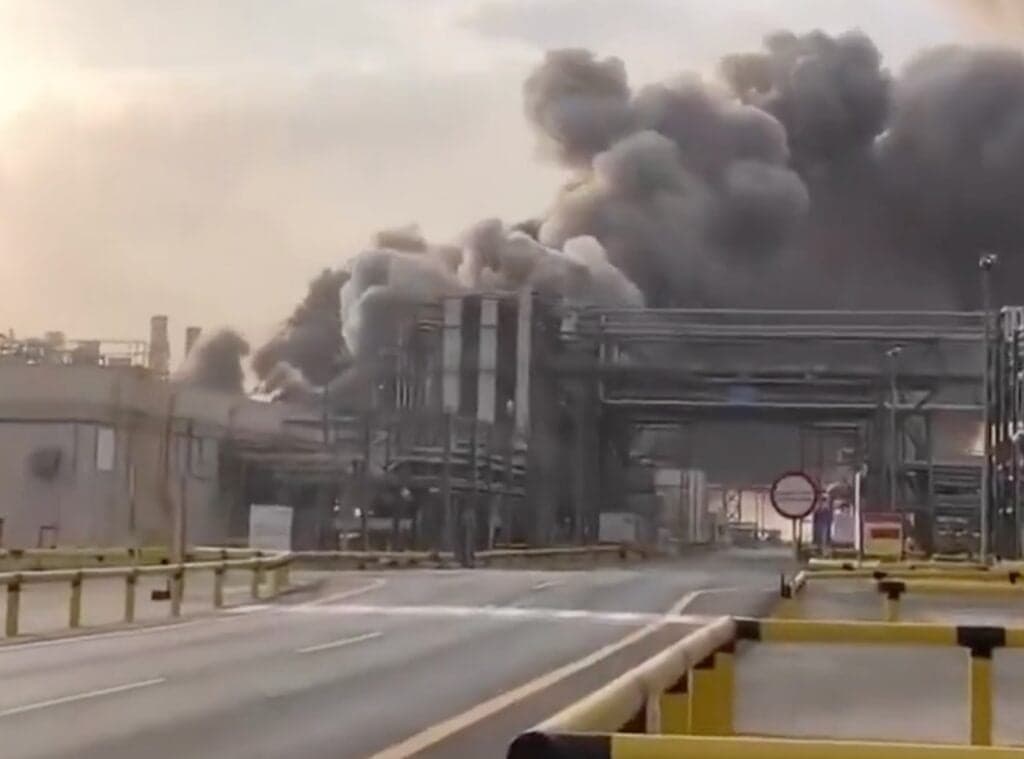
Saudi Aramco, Saudi Arabia’s oil company, also shut down its Ras Tanura oil refinery, following a fire sparked by debris from an Iranian drone attack at the facility.
The shutdown of major production plants and increased global crude prices present a cocktail of shocks for the African market as fears of supply disruption heighten.
For fuel-dependent countries like South Africa, Ethiopia, and Kenya, in the short-term, this translates into increased vulnerability due to their reliance on fuel imports and deep integration into global trade networks.
For a major oil producer such as Nigeria, which now operates a domestic refinery alongside steady crude production, rising oil prices could translate into increased revenue.
Joe Nwakwe, a petroleum engineer and policy expert, said the political tension in the Middle East would trigger oil supply disruptions, heightening supply risks that would inevitably be priced into the market and drive oil prices upward.
“Depending on the scale and duration of these disruptions, a near-term hike in the price of oil and its derivatives is not unexpected,” he said.
For an oil-exporting Nigeria, Nwakwe said this should result in “elevated revenue streams” and “increases in pump prices globally”.
According to Nwakwe, the immediate benefits for Nigeria include higher crude export revenues, increased foreign exchange (FX) inflows, strengthened external reserves, and larger federation account allocation committee (FAAC) disbursements to all levels of government.
However, he cautioned that these revenue gains depend heavily on production levels, noting that without sustained improvements in production efficiency and security, Nigeria may not fully capitalise on any price windfall.
In a policy brief, Muda Yusuf, chief executive officer (CEO) of the Centre for the Promotion of Private Enterprise (CPPE), said every increase in crude oil price translates into additional export earnings and fiscal revenues.
Jide Pratt, an oil and gas expert, added that the geopolitical tensions will also affect fuel sourcing in southern Africa, particularly for jet fuel and gasoil, which are primarily imported from Asia.
WILL EXPORTERS AND IMPORTERS BE AFFECTED?
With major container shipping lines suspending operations through the Strait of Hormuz and the Suez Canal, the conflict is expected to also disrupt supply chains globally, including Africa’s.
Hormuz — a narrow maritime passage connecting the Persian Gulf to the Gulf of Oman and the Arabian Sea — is considered the sole sea route connecting the Gulf’s oil and gas producers to global markets, making it one of the world’s most strategically vital waterways.
About 20 million barrels of oil per day is said to move through the Strait, representing about 20 percent to 25 percent of the world’s seaborne oil trade and roughly one-fifth of global fuel consumption.
Reports also indicate that around 20 percent of global LNG and nearly 11 percent of total global maritime trade transit this critical waterway.
Given the importance of this passageway and its potential disruption, some of the shipping companies introduced new surcharges — including CMA CGM and Hapag-Lloyd.
This will likely translate to higher shipping costs for essential imports to the continent, including fuel, fertilizers, food grains, and industrial components from global partners.
Analysts warn that these increased costs are likely to push up the prices of goods, particularly in countries that rely heavily on imports.
Speaking on the development, Ayokunle Olubunmi, head of financial institutions Ratings at Agusto & Co, said the development will affect trade across African countries — particularly by increasing freight costs for importers — which in turn raises the prices of goods and could lead to higher overall costs for consumers.
SHOULD NIGERIANS EXPECT INFLATIONARY PRESSURES?
Yes. Analysts anticipate mounting inflationary challenges for the continent over the next few weeks.
Inflationary pressure occurs when market or economic factors trigger an uptick in the cost of goods and services.
For example, when geopolitical tensions drive up oil prices, fuel costs also rise — particularly in deregulated markets like Nigeria.
As a result, transportation expenses may climb, manufacturing becomes more costly, and the cost of distributing food increases.
Nigeria’s downstream sector has already responded to the Middle East conflict, with the Dangote refinery increasing its ex-gantry petrol price to N874 per litre on March 2, a move that directly impacts higher pump prices and transportation.
Consequently, Olubunmi noted that rising pump prices could trigger inflationary pressures in Nigeria, potentially eroding recent gains from declining inflation.
Also commenting, Yusuf said the most immediate domestic risk “lies in inflation transmission”.
He added that energy costs have a strong multiplier effect on Nigeria’s inflation, noting that transportation and food prices make up a significant portion of consumer spending.
“With purchasing power already fragile, sustained increases in fuel prices could intensify cost-of-living pressures and deepen poverty levels,” Yusuf said.
“Thus, while government revenues may rise, household welfare could deteriorate — creating a divergence between fiscal gains and social outcomes.”
The National Bureau of Statistics (NBS) had said Nigeria’s headline inflation rate dropped to 15.1 percent in January.
IS THE NAIRA FREE FROM PRESSURE?
The currencies, another key factor that plays a crucial role in shaping fiscal balance across the continent, are also expected to be affected.
In Nigeria, analysts predict that the naira is likely to continue appreciating against the dollar — or vice versa — depending on trade balance, in line with recent trends.
Yusuf said higher oil prices typically strengthen Nigeria’s current account balance and improve FX liquidity.
“This could reduce short-term pressure on the naira and reinforce investor confidence,” he said.
Yusuf also said geopolitical instability triggers global risk aversion.
“During periods of uncertainty, capital tends to migrate toward safe-haven assets such as U.S. Treasury securities and gold. Emerging markets frequently experience portfolio outflows in such episodes,” he said.
“Given Nigeria’s relatively shallow capital market and sensitivity to foreign portfolio investment, volatility in global financial conditions could offset part of the FX gains from higher oil prices.
“The net exchange rate impact will therefore depend on the balance between stronger oil inflows and potential capital reversals.”
WHAT DOES THE US-IRAN WAR MEAN FOR ORDINARY NIGERIANS?
Over the next few weeks, rising petrol prices are likely to hit Nigerians directly, leading to increased transportation expenses — if the war continues.
Experts believe Nigerians are likely to encounter a range of disruptive impacts.
In addition to higher petrol prices, Olubunmi said Nigerians can expect more expensive international travel and elevated prices on imported products, including vehicles.
He added that while deregulation of the downstream sector has its benefits, higher petrol prices could increase the cost of transporting food across the country, further driving up overall prices.
On his part, Nwakwe advised that Nigeria could mitigate some of these downsides by avoiding the treatment of revenues from higher oil prices as mere windfalls.
He advised the government to use these revenues to strengthen fiscal buffers, which could be deployed to subsidise fuel and lower pump prices if disruptions persist, ensuring energy remains affordable. Thecable