



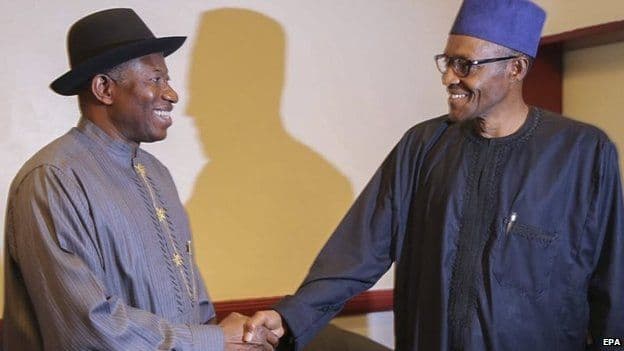
Jonathan and Buhari
Former President Goodluck Ebele Jonathan disclosed on Friday that Boko Haram insurgents nominated former President Muhammadu Buhari to represent them in negotiations with the Federal Government when his administration considered having a dialogue with the group to seek a non-combatant alternative to end the terrorist group’s activities.
Jonathan made this known at the public presentation of “Scars” ‘Nigeria’s Journey and The Boko Haram Conundrum’, a book authored by former Chief of Defence Staff, General Lucky Irabor, in Abuja.
He said in tackling the insurgency which predated him in 2009, his administration established several committees to explore options for peace with Boko Haram and “during one of such processes, the insurgents put forward General Muhammadu Buhari as their preferred negotiator”.
As a result of that, Jonathan said he believed it would have been easier for Gen Buhari, when he emerged as president, to negotiate with the terrorists to surrender, but the insurgency still persisted.
President Jonathan who recalled the processes he championed as Vice President to late President Umaru Yar’adua that brought militancy to an end in Niger Delta, noted that the inability of Buhari to eradicate Boko Haram terrorists, showed that the crisis was more complex than often portrayed.
His words: “If you conduct research and interview many people, you will only get part of the story, but never the full story of Boko Haram. I was there. Boko Haram started in 2009 when I was vice president. I took over in 2010 and spent five years battling the insurgency until I left office. At one of the committees we set up then, the Boko Haram nominated Buhari to lead their team to negotiate with the government
“So, I was feeling that, if they nominated Buhari to represent them and have a discussion with the government committee, then when Buhari took over, it could have been an easy way to negotiate with them and they would have handed over their guns. I thought that after I left, within a reasonable time, General Buhari would wipe them out. But even today, Boko Haram is still there. The issue of Boko Haram is far more complex than it is often presented.
“So, it’s a bit complex, and not a matter of a single story. But I believe, as a nation, we have to look at the Boko Haram issue differently from the conventional approach. I believe one day we’ll overcome it. “One of the major scars on my government, which will remain on my face, as Bishop Kukah said, and no plastic or cosmetic surgeon can remove it, is the issue of the Chibok girls. It is a scar I will die with. But perhaps later, more details may become known, and that too has to do with Boko Haram. What did they really want? Our chairman of this occasion, (Former President Obasanjo) once raised the issue when he interviewed some of them, and they gave him certain perspectives. Vanguard